An agency owner told me his business was in trouble.
Revenue was down. He was working twelve-hour days and still not catching up. He had been blaming himself for about a year. His read on the problem was that his marketing had gone quiet, so he wanted to know where he should advertise. Facebook maybe. Reddit. Some marketplaces.
That is a reasonable place to look. It was also the wrong problem.
What he actually told me
I asked him a few questions over two days. Not clever ones. What does the business bring in, what does it cost to run, how many people, and where does the money come from.
Here is what came back.
Around thirty thousand dollars a month in revenue. Around thirty thousand a month in costs. Roughly fifty people on staff.
So the business was running to stand still. Everything coming in was going straight back out.
Then he mentioned, almost in passing, that revenue used to be seventy thousand.
That one sentence changed the whole conversation. A business at thirty thousand that has always been at thirty thousand has a growth problem. A business at thirty thousand that used to be at seventy has a collapse, and you cannot fix a collapse by advertising harder.
The calculation nobody had run
He had several service lines. The main one was ten years old and had most of the staff on it. Another one was a month old and had two people.
I divided the revenue on each line by the number of people working it.
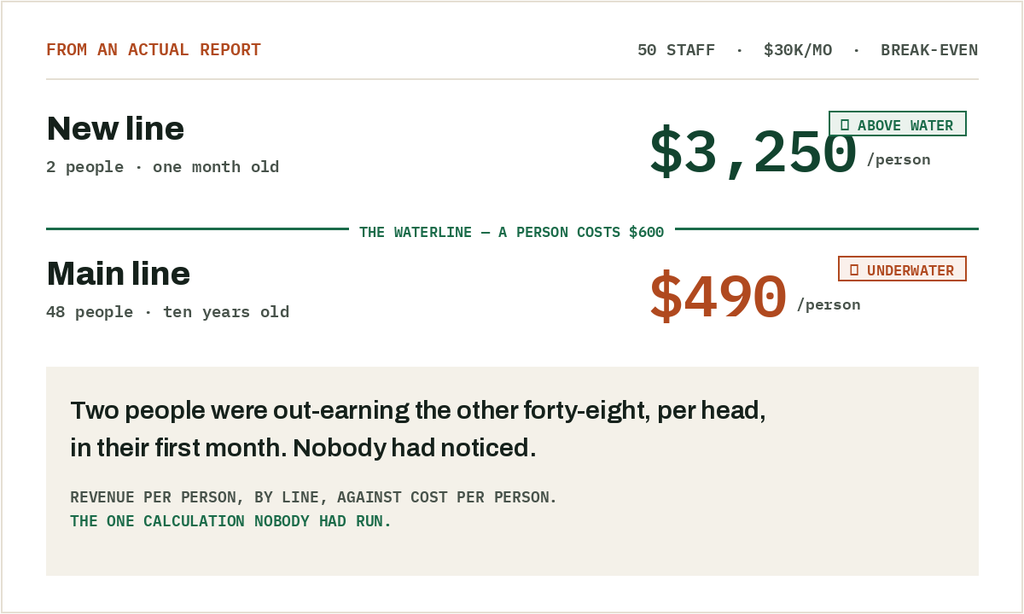
The ten year old line was producing about four hundred and ninety dollars per person.
The month old line was producing about three thousand two hundred and fifty dollars per person.
Then I took his total monthly cost and divided it by his total headcount, which gave a rough cost of six hundred dollars per person.
Read those three numbers together and the picture is hard to miss. His main service line was bringing in less per person than it cost to employ them. The new line, with two people and no marketing behind it at all, was earning more than five times what it cost.
Two people were out-earning the other forty-eight, per head, in their first month.
Nobody had noticed. Not him, not his manager, not anyone in his network.
You can run this same three-number check on your own business in about ten minutes. I built a free calculator that does it, put in your service lines and see which ones are carrying the rest.
Why he could not see it
This is the part that matters, because it is not a story about someone being bad at business. He is good at what he does. He has clients who have stayed with him for ten years. He runs a research operation more thorough than most agencies attempt.
But he was doing four jobs. Marketing, support, research, and quality control. When a client’s results dipped, he personally went in and fixed it. Every problem in a fifty person company ended up on his desk.
You cannot see the shape of something while you are standing inside it holding it up.
And the four jobs were not equal. Three of them had deadlines attached. Clients waiting, work due, problems on fire. Marketing was the only one nobody was chasing him about, so marketing was the one that got dropped. For two years.
He described that as neglect. It was not neglect. It was triage.
The order things actually went wrong in
Once we laid it out, the sequence was clear and it was not the one he had been telling himself.
He expanded into a larger office and spent heavily on the fit-out. Then staffing problems hit and he lost about half his team. Then he spent the better part of a year buried in internal issues instead of running the business. Revenue fell. Marketing had already been dropped somewhere in the middle of that.
He had been carrying the story that ignoring marketing caused the decline. It did not. It was a casualty of it.
That distinction is not academic. If he had fixed marketing first, he would have driven more sales into a service line that loses money per head, on a cost base built for a business twice his current size. He would have worked harder, spent more, and ended up further behind. Then he would have concluded that nothing works.
What most struggling businesses are missing
Not customers. Usually one calculation.
Revenue per person, by service line, against cost per person. That is it. Three numbers most owners already have somewhere and almost none of them have put side by side.
It takes about ten minutes. It tells you which part of your business is paying for the rest of it.
The reason it does not get done is not difficulty. It is that the people who need it most are the ones with no room to step back. If you are working twelve hours a day fixing things, there is no hour in there for arithmetic about your own company.
The thing I keep seeing
Every diagnosis looks like common sense once someone says it out loud. That is what makes this work strange. You spend two days asking questions and reading spreadsheets, and the answer collapses into one sentence that sounds obvious.
It was not obvious. It was invisible, right up until it was written down.
He forwarded the analysis to his manager the same day.
I take businesses apart and show owners what the numbers actually say, then write it up plain. No calls, no retainer, one document. If yours feels like the one above, start a teardown or run your own numbers free first.